


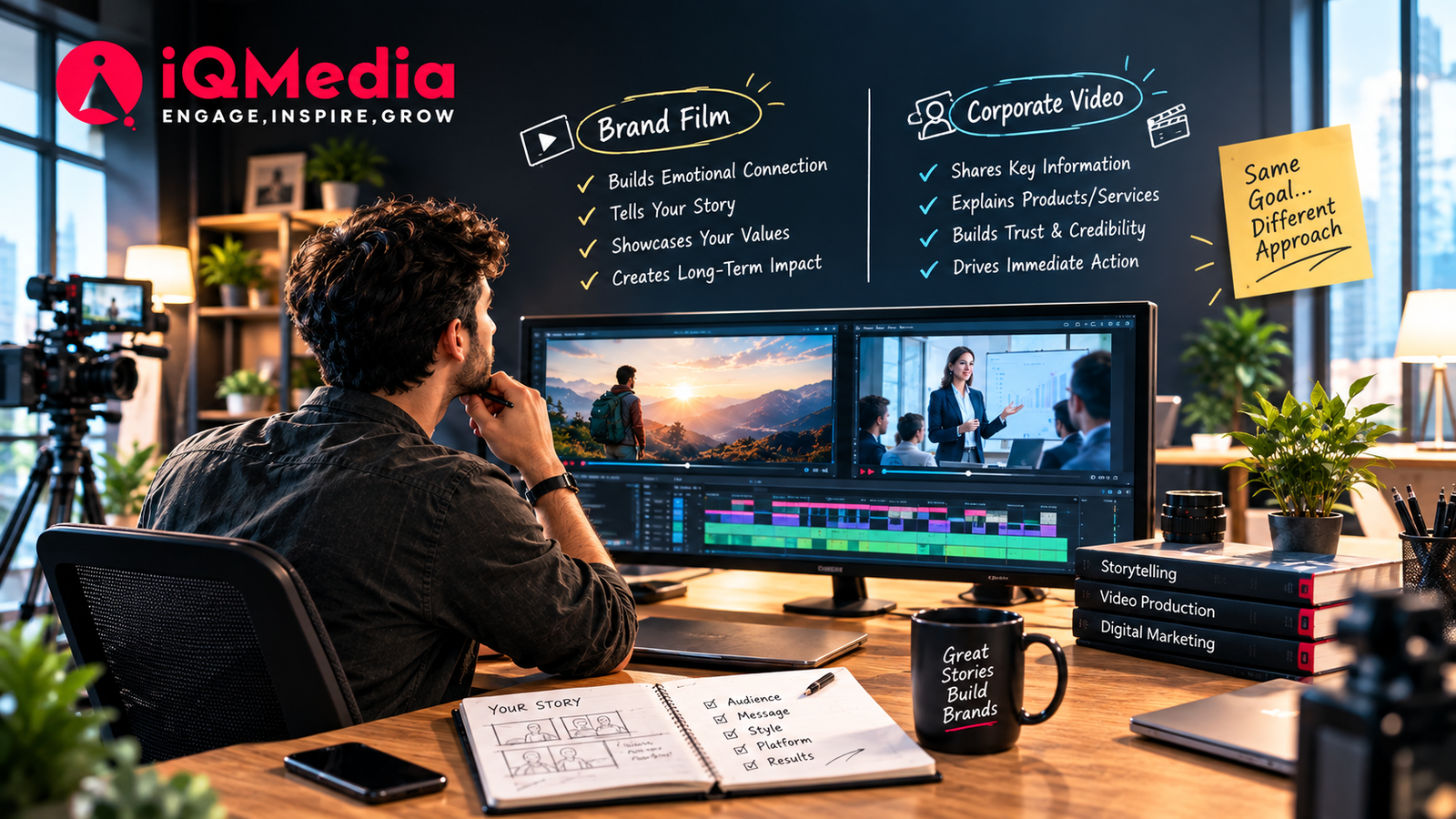
Planning a professional business video often starts with one question: Should you create a brand film or a corporate video?
Both formats help businesses communicate with customers, employees and partners, but they serve different purposes. A corporate video usually explains what a company does, what it offers and how it operates. A brand film focuses more on the story, purpose, people and personality behind the business.
Understanding the difference can help you choose the right format, message and production approach.
What Is a Corporate Video?
A corporate video presents a company's services, products, people, processes or capabilities in a clear and professional way.
Businesses may use corporate videos to:
-
Introduce their company and services
-
Showcase facilities and capabilities
-
Demonstrate products or processes
-
Introduce employees and leadership
-
Present customer testimonials
-
Support recruitment and training
-
Communicate with clients and partners
For example, a manufacturing company may use a corporate video to showcase its facility, machinery and production process. A technology company may use one to explain its software and demonstrate how it helps customers.
The focus is usually on clarity, credibility and useful information. Corporate video production can combine scripting, interviews, filming, graphics and editing to communicate the business effectively.
What Is a Brand Film?
A brand film takes a more story-driven approach. Instead of simply explaining what a business sells, it explores the people, purpose and ideas behind the brand.
A brand film may focus on:
-
Why the company was started
-
Its journey and milestones
-
The people behind the business
-
Its values and purpose
-
The problems it wants to solve
-
What makes the brand different
Brand films can combine cinematic visuals, interviews, music, narration and carefully planned scenes to create a stronger narrative.
For example, instead of simply listing company achievements, a brand film could show how the business started, the challenges it experienced and the people who helped build it.
The goal is to help viewers understand who the brand is and what it represents.
Brand Film vs Corporate Video: How Do You Choose?
The simplest distinction is:
A corporate video primarily explains the business, while a brand film primarily tells the brand's story.
However, the two formats can overlap. A corporate video can use storytelling and cinematic visuals, while a brand film can still include information about products, services and capabilities.
Before choosing a format, ask:
-
What does my audience need to know?
-
What should they remember?
-
What should they feel?
-
What action should they take?
-
Where will they watch the video?
These questions help connect the creative approach to your actual business objective.
Start With Your Business Objective
Before discussing cameras, locations or visual effects, define what the video needs to achieve.
Your objective could be to:
-
Introduce a new company
-
Build brand awareness
-
Launch a product or service
-
Explain a complex offering
-
Attract potential customers
-
Support recruitment
-
Communicate company culture
-
Strengthen brand identity
A clear objective prevents the video from becoming a long list of company information. It also helps the production team determine the right story, script, visuals and format.
Understand Your Target Audience
Different audiences may need different types of business videos.
Potential customers may want to understand your services and benefits. Potential employees may be more interested in workplace culture and the people behind the company. Business partners may want to understand your capabilities and experience.
Before production, consider:
-
Who will watch the video?
-
What do they already know?
-
What problem are they trying to solve?
-
What information do they need?
-
Where are they likely to watch it?
These answers can influence the video's tone, script, visuals, length and distribution strategy.
Build the Story Before Planning the Shoot
Good business videos are not created simply by collecting attractive footage. They need a clear idea and logical story.
Your central story could focus on:
-
A customer problem and solution
-
The company's journey
-
A product transformation
-
The people behind the business
-
An innovative process
-
The company's purpose or mission
Once the idea is clear, scripting and storyboarding can determine which interviews, locations and supporting visuals are required.
A simple structure such as Problem → Story → Solution → Value → Next Step can help keep the message focused.
Planning also helps determine the B-roll, camera angles, interview questions, graphics and sound elements needed for the final video.
How Production and Editing Shape the Final Video
Production quality matters, but every visual should support the message.
A corporate video may include interviews, facility footage, product demonstrations, team interactions and customer testimonials.
A brand film may use cinematic shots, planned locations, narration, music and storytelling sequences.
Depending on the project, businesses can also use animation, motion graphics, product cinematography and professional sound recording.
Editing brings these elements together. Professional video editing can improve pacing, organise the story, balance audio, add graphics, refine colour and create versions for different platforms.
The goal is not simply to make the video look polished. Production and post-production should make the message easier to understand and remember.
Can One Production Create Multiple Content Pieces?
A well-planned production can generate more than one final asset.
For example, one project can provide:
-
A main website video
-
Short social media clips
-
LinkedIn videos
-
Promotional cutdowns
-
Interview snippets
-
Behind-the-scenes content
If these requirements are discussed before filming, the production team can capture additional footage and framing for future content.
This can help businesses use one production across their website, presentations and social media campaigns.
What Should You Look for in a Video Production Partner?
When choosing a video production company in Coimbatore, consider more than equipment and pricing. The production partner should understand your business objective, audience, message and intended platforms before planning the shoot.
Useful capabilities include:
-
Concept development
-
Scriptwriting and storyboarding
-
Professional filming
-
Corporate video production
-
Video editing
-
Animation and motion graphics
-
Sound design
-
Colour correction
-
Post-production
-
Platform-specific content delivery
A production partner should also be able to explain why a particular storytelling approach and visual style suits your objective.
If you already have footage, a video editing company in Coimbatore can also help organise, refine and repurpose existing content into useful formats.
When Is Each Format Suitable?
A corporate video can be suitable when you want to explain your company, showcase facilities, demonstrate a product or process, introduce your team, present testimonials or support recruitment.
A brand film can be suitable when you want to tell your company's story, communicate its purpose and values, strengthen brand identity or create a stronger emotional connection with your audience.
The decision should ultimately depend on the message, audience, objective and platform.
Frequently Asked Questions
1. What is the main difference between a brand film and a corporate video?
A corporate video generally explains a company's business, services, products or capabilities. A brand film focuses more on the company's story, purpose, values and identity.
2. Which video is better for explaining products or services?
A corporate video can be suitable when the main goal is to explain a product, service or process clearly. The choice should depend on the audience and business objective.
3. Can a corporate video also be creative?
Yes. Corporate videos can use storytelling, music, interviews, animation and cinematic visuals while maintaining a clear business message.
4. Can existing footage be used for a new business video?
Yes. Existing footage can be combined with new filming, interviews, narration, animation, motion graphics and professional editing.
5. How long should a brand film or corporate video be?
There is no fixed duration. The appropriate length depends on the audience, platform, purpose and amount of information being communicated.
Conclusion
Choosing between a brand film and a corporate video starts with your objective, audience and message.
For professional video production, IQMedia offers corporate video production, video editing, animation, motion graphics and post-production services tailored to the project's communication goals.
Have a video project in mind? Talk to IQMedia about your requirements.