


In today’s world, sustainability is no longer just a trend—it has become a responsibility for businesses across industries. The media and film production sector, known for its high energy consumption, equipment usage, travel requirements, and waste generation, is also evolving to reduce its environmental footprint. At IQMedia, sustainable filmmaking is not just an idea; it is a practice embedded into every stage of production.
Green video production focuses on minimizing environmental impact while maintaining creative excellence. Through innovative workflows, responsible resource management, and eco-friendly technologies, IQMedia is helping reshape how visual content is created.
Why Sustainable Filmmaking Matters
Film and video productions often require significant resources, including lighting equipment, transportation, power generation, and set materials. Without sustainable planning, these elements can contribute to carbon emissions and unnecessary waste.
Adopting green production practices helps organizations:
Reduce carbon footprint
Minimize energy consumption
Cut down production waste
Promote environmentally responsible storytelling
Build a stronger brand reputation among eco-conscious audiences
By integrating sustainability into filmmaking, companies like IQMedia ensure that creative storytelling does not come at the cost of environmental health.
IQMedia’s Approach to Green Video Production
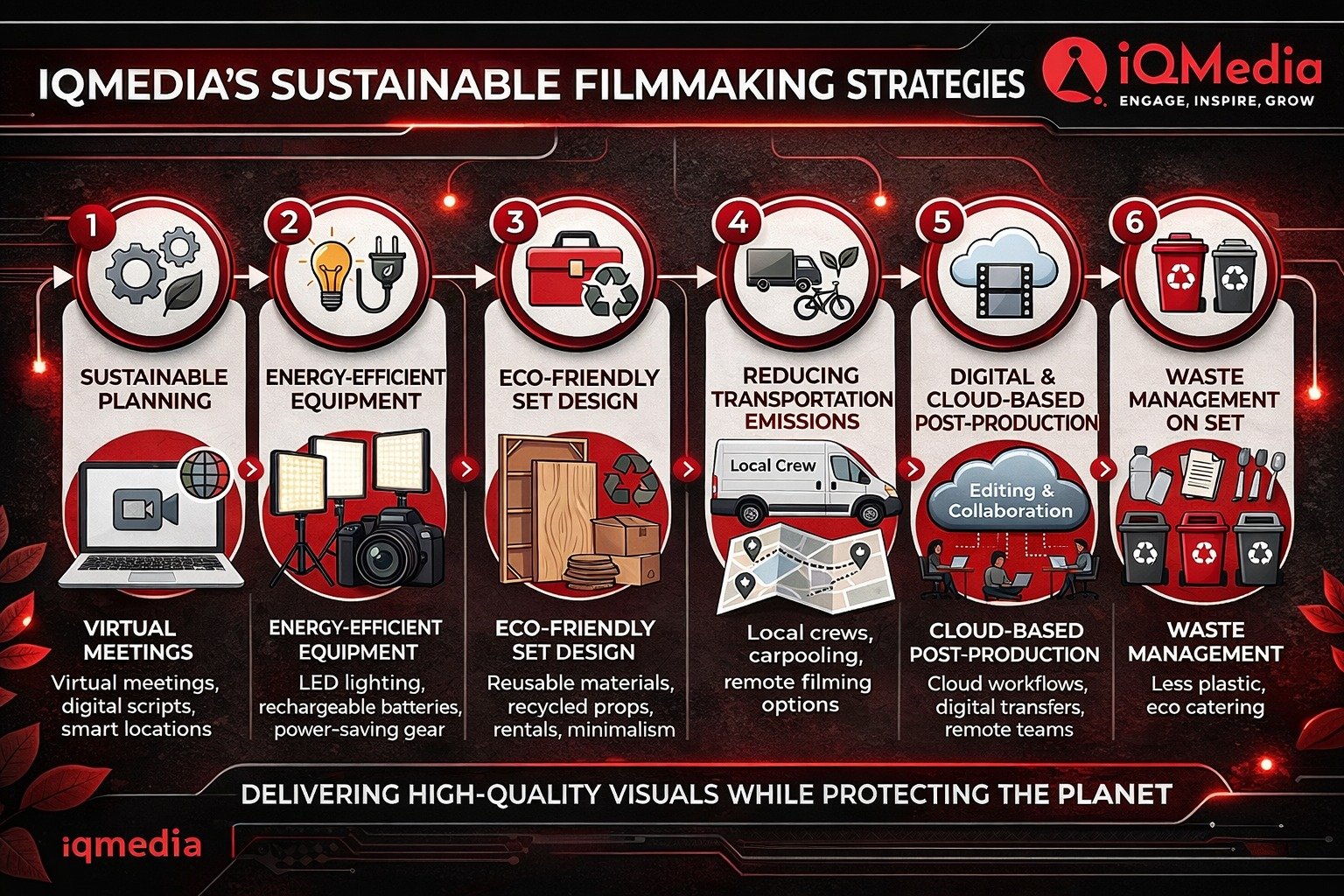
IQMedia incorporates sustainability across the entire production lifecycle—from pre-production planning to post-production delivery. Their strategy combines technology, efficient workflows, and environmentally responsible decision-making.
1. Sustainable Pre-Production Planning
Sustainability begins before the cameras start rolling. IQMedia prioritizes efficient planning to reduce unnecessary travel, material usage, and energy consumption.
Key practices include:
Virtual meetings for project coordination
Digital scripts and documentation to reduce paper usage
Smart location selection to minimize travel distances
Efficient scheduling to reduce production days
Careful planning ensures that every resource is used responsibly while keeping production timelines smooth.
2. Energy-Efficient Equipment
Lighting and camera equipment can consume large amounts of electricity. IQMedia addresses this by using modern, energy-efficient technology.
Examples include:
LED lighting systems instead of traditional high-power lights
Energy-efficient cameras and monitors
Rechargeable battery systems
Power-saving production equipment
These solutions significantly reduce power consumption without compromising production quality.
3. Eco-Friendly Set Design
Traditional set design can generate a lot of waste through temporary structures, plastic materials, and disposable props. IQMedia encourages sustainable alternatives such as:
Reusable set materials
Recycled props and décor
Minimalistic set designs
Prioritizing the rental of equipment and props to reduce the need for manufacturing and purchasing new items.
This approach reduces landfill waste while keeping production flexible and cost-effective.
4. Reducing Transportation Emissions
Transportation is one of the biggest contributors to a production’s carbon footprint. IQMedia minimizes this impact by:
Choosing local crews and locations
Consolidating equipment transportation
Encouraging shared travel options for crew members
Using remote filming technologies when possible
These strategies significantly reduce fuel consumption and travel-related emissions.
5. Digital and Cloud-Based Post-Production
Post-production is another area where sustainable innovation plays a key role. Instead of relying on physical storage and large office infrastructures, IQMedia uses digital workflows.
Benefits include:
Cloud-based editing and collaboration
Digital file transfers instead of physical media
Remote editing teams
Reduced office energy consumption
These practices improve efficiency while lowering environmental impact.
6. Waste Management on Set
IQMedia implements responsible waste management practices during filming to ensure minimal environmental impact.
These include:
Recycling stations on set
Reduced single-use plastics
Eco-friendly catering options
Reusable water bottles and containers for crew members
Small changes on set can collectively make a big difference.
The Future of Sustainable Video Production
As audiences become more environmentally conscious, brands are expected to adopt responsible production methods. Sustainable filmmaking not only protects the planet but also demonstrates a company’s commitment to ethical practices.
IQMedia continues to explore new technologies and production models that reduce environmental impact while delivering high-quality visual storytelling.
By embracing green video production strategies, the company proves that creativity and sustainability can go hand in hand.
Final Thoughts
Green video production is transforming the future of filmmaking. Through thoughtful planning, energy-efficient technology, and responsible production practices, IQMedia is setting an example for the industry.
Sustainability is no longer optional—it is the future of content creation. And with companies like IQMedia leading the way, the media industry can continue to inspire audiences while protecting the environment.